In 1915 it was sent back to the factory to be extensively reworked. On its second debut it sported an inner level that was six inches higher than the outside row floor to make room for the mechanisms of two rows of jumping animals. It had also been refitted with a commutator and hundreds of glittering electric lights.
Despite the valiant efforts of its many supporters, the city fathers decided to take the old carousel out of service and sell off its magnificent menagerie of animals. The tarnished and tattered leftovers were thrown into an old truck trailer and put up for sale.
An Atlanta man named Charlie Walker realized its potential, rescued the stripped remains and put them into storage. For decades the old machine lay waiting to be discovered by just the right person. The tangle of wood, canvas and metal continued to slowly deteriorate. Soiled by pigeons and chewed by mice, it required a unique person to recognize its promise and have the courage and determination to rescue it.
Early in the 1980's, that person happened along. Bud Ellis had sought out Charlie Walker to purchase a band organ for his small portable machine. Instead, he discovered the, by now, almost unrecognizable wreck and fell in love. That love sustained him through almost 10 years of meticulous restoration.
Bud kindled sparks of his own enthusiasm in his hometown of Chattanooga. There along with other enthusiasts, he started an organization called "Friends of the Carousel". With their help, he trained carvers, recruited an army of volunteers, secured funding and laid claim to a spectacular location for the restored machine in a specially developed park right on the banks of the Tennessee River.
To house this hand-made treasure the city commissioned a sparkling glass building topped by a gilded weathervane pointing the way to future dreams.
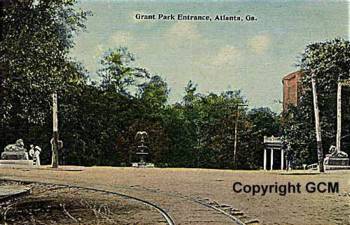
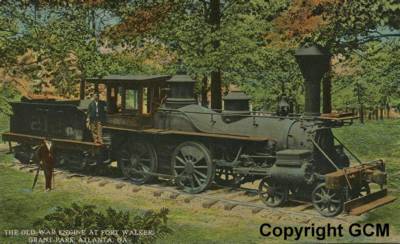
Sidney Root, a pioneer Atlanta merchant, played a role in the early development of Grant Park. It is reported that his love of trees and nature inspired him to suggest to Grant, a prosperous railroad engineer from Frankfort, Maine, who had moved to Atlanta in 1840, that the land be donated to the city. The land was a piece of the city's history, because the crown of the hill (near the Boulevard and Atlanta Avenue entrance) was the commanding position held by a Confederate battery in 1864 and contained Old Fort Walker and entrenchments.
When the land was deeded to the city, Mayor John B. Goodwin appointed Root president and general park superintendent, and Lemuel Grant served on the park commission. The supervising of the construction of the park was left to Root, who remained in charge until his death in 1897.
As soon as the city took over ownership of the park, it spent $1,500 to improve its grounds. By 1885 the city extended its corporate limits to include the park. Mayor George Hillyer noted in an annual address to the city council that L. P. Grant Park, or Grant's Park as it came to be known, was a source of pride and that the hardworking and industrious people of Atlanta deserved such a place of recreation.
A Zoo was added to Grant Park in 1889. The animals were a gift of Atlanta lumber dealer George V. Gress, who had purchased a defunct circus for the wagons and railroads cars and offered the animals to form Atlanta's first municipal zoo. With the addition of the zoo, the city desired more land. The park was extended to 131.5 acres on April 4, 1890, when the city purchased 44 more acres from Lemuel Grant to the north of the original tract, in Land Lot 44.
A few years later Gress and Charles Northern purchased a cyclorama painting, The Battle of Atlanta, which was placed on exhibit in a circular building on Grant Park grounds in 1892 and donated to the city in 1898. The Cyclorama is the largest painting in the country, at 42 feet tall and 358 feet in circumference. It was originally commissioned by General John "Blackjack" Logan (who had unsuccessful vice-presidential ambitions) and depicted a charge Logan led after the death of General James McPherson. In 1921 the cyclorama was moved to a building designed by Atlanta architect John Francis Downing. The painting and its specially designed building were renovated in 1979, following storm damage and general deterioration, and reopened to the public in 1982.
Grant Park contained Lake Abana and Willow Brook. Lake Loomis was built adjoining Lake Abana in 1888, and the two later merged. Lake Abana was again enlarged in 1900, expanding from four acres to six acres and containing two islands. There were also several springs of mineral water in the park, the most prominent of which was Constitution Spring. Because of the contamination of Willow Brook and Constitution Spring, Lake Abana was filled with water from the city's reservoir starting in 1906.
By 1902 Lake Abana in the southwest corner of the park was equipped for swimming and boating, and at one end of the lake was a large pavilion where motion pictures were shown. The park also had tennis courts and a greenhouse in which shrubbery and flowers were cultivated to be used in all the city's parks. In 1917 a pool measuring 500 feet long and 200 feet wide was added in the park.
In 1935 Asa G. Candler Jr. made a gift to the zoo of his private collection of 84 wild animals and nearly 100 birds. He had kept the animals at his house on Briarcliff Road, much to the dismay of his neighbors. He rejected a bid by the city of New York as being too low. Instead, he offered the collection as a gift to the city of Atlanta if suitable housing was provided. Through donations, the necessary funds were raised and the animals were added to the existing municipal zoo at Grant Park.
Through the years the park has seen many changes. The pool and Lake Abana were drained in the 1960s, and acreage was added. The zoo has continued to grow, and the early pavilions have been removed. An antique carousel was placed in the park in 1966.