December 20, 1866, Georgia Legislature grants a charter to the Savannah, Skidaway and Seaboard Railroad Company to build rail lines to Thunderbolt, the Isle of Hope and Skidaway Island


The last great hurricane to come ashore at Tybee did so in 1898, at which time the island was covered and sustained major damage to 80 percent of its structures. There was also significant loss of life during this storm. Paradoxically, as shown from studies done by Martha Griffin (Georgia Department of Natural Resources) and by Frank Poesy and Wade Seyle (U. S. Army Corps of Engineers), the island's land mass had enlarged appreciably through 1900,despite the serious storms. However, the island's beaches have eroded steadily from 1925 to the present. Millions of dollars have been used for erosion protection, and it is expected that millions more will be necessary in an attempt to maintain the island's present physical boundaries.

The Tybee lighthouse is the oldest and tallest lighthouse in Georgia. In 1773, a 100-foot tall Daymark tower was erected to aid ship traffic along the eastern seaboard and Savannah River. During the Civil War, Confederate troops destroyed the upper levels of the tower to hinder Union advances. The present lighthouse was built in 1867 top the 1773 foundation. It is 154 feet tall and constructed of brick and metal. It was converted from oil to electricity in 1933, using a single bulb of 1,000 watts. Light through the 10 foot Fresnel lens can be seen from 18 miles out at sea. There are a total of six historic buildings on the Tybee Island lighthouse site, the oldest being the kitchen (circa 1812). Other buildings on the sites include the oil house and the keeper's cottage.

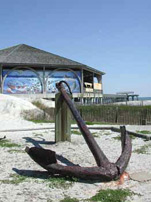
Tybee Island Pier and Pavilion

In 1887, the Savannah and Atlantic railroad was completed to Tybee Island. It was bought by the Central of Georgia Railway in 1890 and continued under this management until the Tybee railroad was abandoned in 1933.Probably more than any other thing, the railroad made Tybee Island the greatest seaside resort in Georgia by making the island easily accessible to everyone. The line ran 14 miles from Savannah to Tybee and required about a one-hour ride to complete. Completion of U. S. Highway 80 in June 1923 was the beginning of the end for the Tybee railroad. Business declined, and 10 years later the line was abandoned. Much of the old railroad grade still exists today. In 1991 the Chatham County rails into trails committee began efforts to convert a portion of the abandoned railroad grade into a multi-purpose hiking and bicycle trail.

Of all the piers and pavilions built on Tybee, Tybrisa was the largest and best known. The Central of Georgia Railway operated it. The Tybrisa Company purchased the pavilion from Central of Georgia in 1924. A fire in 1967 destroyed the pavilion. It was not rebuilt until 1996/97 by use of 1% sales tax monies appropriated by Chatham County. The remaining support poles from the pier were removed as a public safety measure, and today there is little remaining physical evidence of Tybrisa. Just north of 16th street, the approach entrance to Tybrisa can still be seen.


CREDITS: Excerpts: Clippings and 'Notes' courtesy of Savannah Library