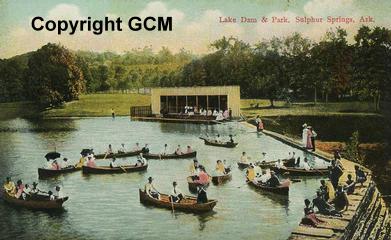
In 1889 a natural lake formed by Butler Creek was drained in the town, resulting in the discovery of three more mineral springs, which prompted Mr. Hibler to christen the town Sulphur Springs. In that year a train line on the Kansas City, Fort Smith and Southern Railroad was built from Split Log, Missouri and town experienced a boom in growth. By 1890 Sulphur Springs was legally incorporated.
Mr. Hibler constructed an 11-acre park revolving around the springs and Lake LaBelladine, with islands to entertain the tourists. The park featured a tabernacle, dance hall, roller rink, golf course and miniature train. The lake was host to fishing tournaments and swimmers and several elaborate hotels and bathhouses were built to accommodate visitors. The Kilburn Hotel was considered the largest in Northwest Arkansas in 1909. Sulphur Springs was thriving and the flow of the mineral springs was such that it could supply 10,000 people with water. It was in this atmosphere during the heyday of the American bath and spa era that Mr. Warren Prickett came to town to construct his summer home. Mr. Prickett was General Southern Manager of Long Bell Lumber Company of Kansas City, Missouri. After the death of Mr. Prickett in 1934, his wife moved to the home in Sulphur Springs year round. In later years her health began to fail so she moved to her daughter's in Georgia where she died. Since that time Wee Pine Knot has remained a year round single-family home.
In 1912 the Sulphur Springs Electric Light Company was destroyed by fire. The loss of this source of employment and the southern extension of the Kansas City Railroad caused a drop in tourism revenues and population after World War I.
In 1924 the John Brown University purchased the Park Reserve and the school was installed in the Kilburn Hotel. In order to protect his students John Brown abolished town dances and all mixed bathing in the city park and pronounced his intent to construct a "jazzless, danceless" university. The struggling town continued to suffer under Reverend Brown's oppression. U.S. Highway 71 was put through the golf course in the Park Reserve in 1926 and the 1930s saw the destruction of several of the elegant hotels and bathhouses in town, causing a significant drop in tourism. By 1956 the dam on Lake LaBelladine in the park had washed out and John Brown University put the Reserve up for sale.
The saving grace came from Mr. Aubrey Johnson, a Sulphur Springs resident who purchased the park and entered into a contract with the city to buy the area back. The park acreage was increased in 1957 to 16 1/2 acres when Mrs. Minnie Williams left 4 1/2 acres to the city. The dam was rebuilt in 1976 using concrete and the lake was returned to the citizens. The city is not the bustling boomtown it was at the turn of the century but its charm and natural beauty remains intact with the Park Reserve at its core to remind one of its resort town heritage.