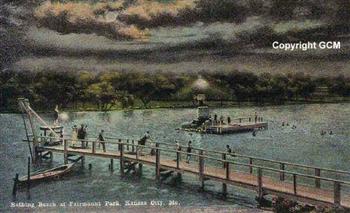
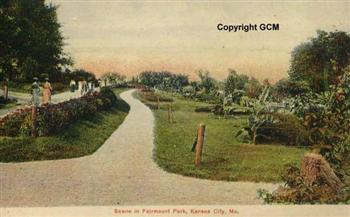
The amusement park, with an eight-acre lake, boasted the usual park rides and entertainment. It included Shakespearian stock, Swiss bell rigers, aerialists, giant dipper rides, a zoo, horse racing, a nine-hole golf course and fine band music. One Fourth of July the elaborate fireworks attracted 53,000 people.
Patrons often stayed a week. Cottages, without cooking facilities, were available. Patrons enjoyed hearty meals at a large dining hall. Eight cottages were privately owned.
The crowd would include people like Wm. Jennings Bryan, theatrical stars, local Kansas City society, Loula Long (still in braids) and James A. Reed, who usually spoke on Labor Day.
Horse shows held here became the forerunners of our annual American Royal stock show, and a group of young blades at the race track formed a club which later became the Kansas City Athletic club.
Today the park and lake are gone. Winding drives and suburban homes fill the area. Only the Sugar Creek ball park gives a clue. It occupies space once used for a large bathhouse, on the old lake front.
Canoes and boats were available to rent and a long bathing beach as seen in the background of the picture, boasted impressive diving structures and a 2-story bath-house where bathing suits, caps and life preservers were also for rent.
The park was Arthur E. Stillwell's creation and was planned primarily to furnish trade for his Air-line interurban line, which ran from 2nd and Grand to Independence. The idea was successful and records show that as many as 15,000 fares were collected in a single day.
There was no air conditioning at the time, but the fast, breezy car ride to the country with windows wide-open was a cooling experience and one of the chief incentives for going to the park.
For the years between 1897 and 1901 a 9-hole golf course was maintained for the newly organized private Evanston Golf Club. The list of club founders included R. W. Hodge, R. George B. Norberg, John Harriss, John Lumpkin, Earnest A. Cronin, Neal S. Doran and Albert Young. (By 1908 the club had moved to the old Swope home, near Swope Park, and had a membership of 300, among them Colonel Swope.).
Fairmount park suffered a bad fire loss in 1933 and water pollution and the depression finally ended park operation.
No trace of the park remains today. Buildings have been razed, the lake has been drained and the terrain leveled.
Comfortable suburban homes on tree-lined roads occupy the 50 acres once so popular as a recreational area.