Early on, family picnics were in fashion. As the park became more popular and the area developed, fortunes were made. A park at the end of a rail line was a common practice in other parts of the nation, and because of an influx of capital from eastern cities such as Boston, Kansas City was on the cutting edge of the new technology.
Washington Park was the most picturesque spot between the Allegheny Mountains and the Rockies. Washington Park was huge, 382 acres, one mile east to west, one and a half miles north to south. Covered with blue grass, rocks as big as houses, and beautiful wild flowers and ferns. Horse drawn open summer cars were boarded on 12th St. and 15th St. and slowly headed east. They crossed a then crystal clear Big Blue River at 15th Street, detraining at the bottom of the big bluff.
Because of the Park's large size, both ends had entrances. After a long walk up the bluff, the west, i.e., the first entrance was at Stark Avenue. Another entrance was by Rock Creek, and one in the middle. The north entrance was where the bus stop is now. Many of the patrons would enter the park at one end and, after a day of fun, return to the city from the other.
The high ground on Blue Ridge was then called Bald Nob. A 107 foot lookout tower was built and a museum at its base featured old coins, books, and other historical curiosities. Several rustic foot bridges crisscrossed Rock Creek, linking nature with the man made attractions. The springs were linked by a bridge to the double L-shaped pavilion, which included a large restaurant. A band stand was already in use, attracting many quality musicians. It is said Jesse James and the boys once hid among the huge rocks and thousands of trees, like the Oaks, Elms, Hickorys, Sugar Maples, Basswoods, Sycamores, Mulberrys, Locusts, Wild Cherry, and Paw Paws.
The flat ground from where now there is a Dairy Queen, to Al Waits Service Station, was the ball field, the hill to the east were the bleachers and above this was the camping ground. The 20 acre lake featured an island for picnickers. Two steam-powered boats were already in dry dock and workmen were optimistically painting oars and John-boats, in preparation for the liquid fun. No dancing or ball playing on Sunday and, of course, gambling and strong drink was never allowed. Admission to the park was free and uniformed watchmen always patrolled the grounds.
However, even with all the hoopla, Washington Park never did catch on. It did set the stage for Fairmount Park, when, in August, 1891, the ninth annual reunion of the ex-Confederate Veterans of Missouri, was held in Washington Park. Across the state, there were 1500 members and more than a third attended. Jackson County alone had more than 1800 former rebels. Among the notables were Generals Jo Shelby, Joe Blackburn and Elijah Gates. They led the divisions in parade from 6th & Broadway to 15th & Grand, where the soldiers boarded trains for Washington Park. Besides the thousands of soldiers of both armies, there were three senators and various state, county and city VIPs. Next came the fire department, the retail clerks, the 3rd Regiment and Battery B. For 2 days the park was transformed into a military camp. North of the 15th Street tracks there were 5 command tents and 250 smaller ones. Tables to feed 2,000 people at a time were spread out under the trees.
An old vet put it this way, "Jackson County was the hot bed of strife during the war. The animosities here were the strongest just after the war. Now our children have been raised and educated with the children of Union Soldiers. They have formed lasting friendships and our sons and daughters have married the children of the men we fought. Here we want to meet them and bury our animosities."
As many as 40,000 people passed through the park in those two days. The veterans paid a dollar for each badge to identify them and their unit. The money went to the veterans home, just purchased in Higginsville; $18,500 for 362 acres. Many of the men were destitute, causes being wounds received while serving the Confederacy or were disowned by family. These men did not have to pay for their badge or anything else at Washington Park.
He also was the president of a street car line serving the park, the Kansas City, Independence and Park Railway, completed in September, 1887. The company operated steam cars, covered with dummy tops (to keep them from frightening horses).
Through the park ran the sparkling Rock Creek which Winner dammed in 1887 to form a 20-acre lake, used for swimming and boating and enhanced in places by the natural beauty of a rocky tree-lined shore.
Musical shows, such as Pinafore, were performed on summer evenings from the deck of a ship tied to a dock, with the audience sitting on chairs on a grassy bank. A covered bandstand was built on an island in the lake, and concerts were given there.
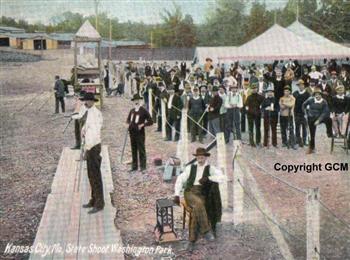
There also was a lecture platform and a dance pavilion. There were the usual concessions and rides, and picnic tables and benches were scattered throughout the shady park. Birds and wildlife were numerous and protected. All the trapshooting clubs of Missouri gathered for an annual state shooting event at Robert W. Elliott's shooting park at Mount Washington. Live pigeons were used as targets.
The park closed in 1900, due to the competition of Fairmount park which had more direct transportation. Since that time the old park grounds have been the property of Mount Washington Cemetery. Today the lake is filled in and landscaped and the wooded grounds of the old amusement park includes the graves of more than 30,000 persons, many who once enjoyed the pleasures of old Mount Washington Park.