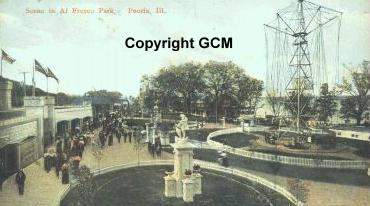
Also in the park was a two-story pavilion called the Japanese Garden. The second floor featured a movie house that frequently screened films by Charlie Chaplin, while the ground floor housed a pavilion and beer garden. This area hosted a number of vaudeville acts and other performances. Some of the famous faces to grace the stage were escape artist Harry Houdini and boxers John L. Sullivan and Jim Corbett. Frequent performers included bands and orchestras, Buffalo Bill's Wild West Show, and the Cherry Sisters, a three-person singing act.
The Cherry Sisters hailed from Iowa, where their father was forced to mortgage his farm. The sisters formed their singing team to help him. They were by far the most popular act, despite the fact that they sang so badly audiences would throw things at them, forcing them to perform from behind a screen.
Another important draw to Al Fresco was Dewey Beach, which allowed visitors the opportunities to swim and fish. Two bath houses lined the beach, where bathing suits could be rented for 10-25 cents. Fishing boats were also available. Al Fresco's boat dock contained a popular barge decorated to resemble a battleship.
Admission to the park was 10 cents for adults and five for children, and in the summers between 1905 and 1927 nearly 10,000 people visited the park daily. Vacationers poured in from all around the Midwest, most of them traveling by ship from St. Louis and Chicago. Locals flooded the park as well, and arrived there by various modes of transportation. Some came by streetcar, while others simply parked on Grandview Drive and walked their way to the park via Gibson Pathway. Those who could afford it took steamboat rides from downtown Peoria.
One 1918 steamboat ride in particular ended in tragedy. As the Columbia brought passengers back downtown after a day's fun at Al Fresco, a whole was torn in the hull, claiming the lives of 87 of the 500 passengers aboard, according to Bill Adams of the Journal Star, 1993. A memorial was dedicated to the victims in 2003.
For most of the twenty-odd years that Al Fresco was in business, however, it maintained the air of innocent fun that Seaver had anticipated. The park and its attractions flourished until the late 20s. Attendance rates began to drop during World War I, but natural causes would ultimately result in the death of the park. During the 20s, the Illinois River, raised by Chicago drainage, permanently flooded portions of the park. Several rides were damaged by this flooding and were never repaired. The dismantling of the famous figure-8 roller coaster in 1928 marked the end of Al Fresco Amusement Park as it was formerly known.