Now an 87-year-old grandmother, Lebowitz still lives in the 13-room home (her husband died in 1997) and wants to stay there. By next summer, she could have a front-row seat at the first public park in Fairfax County designed especially for disabled children. The park in her back yard was Lebowitz's vision -- and her gift to the county.
"I just didn't want to sell it and have little houses built all over it," Lebowitz said, sitting at her dining room table, making a dismissive gesture at the thought. "The best way to do it would be to have a park."
A park it shall be, and one with an unusual name: Clemyjontri. Lebowitz fashioned the name from her children's first names: Carolyn (Cl), Emily (emy), John (jon) and Patrina (tri). Shortening family names is a Lebowitz tradition; Mortimer C. Lebowitz used part of his first name for the Morton's department store chain he founded in the Washington area. The stores closed 10 years ago, but Lebowitz is still remembered by many longtime area residents as a civic leader who championed racial justice. Now, through Clemyjontri Park, his wife is taking up the cause of accessibility for disabled children.
"I've always been interested in children, and it seemed to me there should be a way that handicapped children should be able to feel less handicapped," she said, looking out her front window at children playing during a groundbreaking celebration for the park last month. "I prefer to do that, rather than leave it until after I'm dead."
Lebowitz said she approached the Fairfax County Park Authority three years ago about donating the land after developers asked her if she wanted to sell it (the property is worth as much as $30 million, depending on the zoning). She told park officials she wanted to live in the house until she died, after which the county could have the house, too. Lebowitz's only other stipulation was that the park should be completely accessible to children with physical disabilities.
That presented not only design challenges but financial hurdles as well. It costs up to 50 percent more to build a fully accessible playground than a traditional one.
Special equipment -- supportive, high-backed swings and wheelchair-accommodating gliders, for instance -- is expensive, and a non-mulch surface that allows wheels to roll with ease costs about $500,000. The total price tag for the two-acre playground, scheduled to be completed next fall, will be about $2.4 million.
The Park Authority does not have all of the necessary funds, so it has partnered with the Fairfax County Park Foundation, a private, nonprofit agency, to help raise the remaining $500,000. So far, about $270,000 has been donated.
"Once we had a chance to talk to Mrs. Lebowitz and hear her dream, we just embraced it," said Jean Van Devanter White, executive director of the Park Foundation. "When people hear about this park, they want to support it."
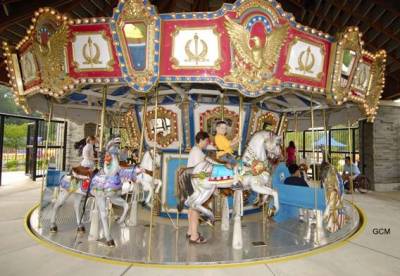
One of the park's prime selling points, literally and figuratively, is the carousel that will be its centerpiece. Its 14 horses and three chariots have been offered to donors for $10,000 each, which gives contributors the right to have their name on the equipment. Fourteen of the 17 pieces have sold. The carousel itself can be named for a cool $100,000. Bricks are also being sold for $100 each.
The playground will be divided into four "rooms," or themed sections. Equipment in the "rainbow room" will include Braille and will accommodate all levels of physical ability. A "schoolhouse and maze" area will focus on learning games involving time zones, maps and clocks.
The "movin' and groovin' " transportation area will include equipment that teaches balance, stimulates the imagination and lets kids feel as if they're driving on a real road, complete with traffic signals. The "fitness and fun" area will provide progressive challenges for physical strength as well as that most important of playground benefits: ways for kids to burn off energy.
The equipment is tailored to disabilities: lowered monkey bars, a glider that a wheelchair can roll onto, special swings with easy entrances and quiet spaces where autistic children can rest. Near the playground will be a picnic pavilion, complete with specially designed tables with cutouts that accommodate disabled children, a storm water pond and accessible restrooms.
Only two of the park's 18 acres will be set aside for the playground; the rest will include natural areas, open space, trails, gardens and, eventually, the Lebowitz home. The park will be open to all children and adults, officials stressed.
"The idea is to have a place where people can come out for the day," said Lynn Tadlock, director of the Park Authority's planning and development division, her eyes sweeping the property. "This was her vision. This was totally her idea, and we were happy to work with her."
At the groundbreaking ceremony, Lebowitz made a brief appearance, accepting a bouquet of flowers from an appreciative crowd that included community members, parks supporters and local government officials.
Children, some in special wheelchair strollers and others who were not disabled, rolled or sauntered across Lebowitz's grand front lawn, eating ice cream and popcorn, tickling a patient goat from a petting zoo, and shrieking and jumping on the moon bounce.
The talk among some of the people there, many of whom have been involved with the park's planning, often turned to Lebowitz. Neighbor Don Perry, who owns Clean Cuts, a service station and auto detailing shop nearby, said that at first he didn't even know there was a house at the end of the long, tree-lined dirt road leading from Georgetown Pike. Now, he said, he hopes to periodically donate a portion of profits from the gas station to the park.
"She has a dream. She has a dream for kids," said Perry as he wandered about the grounds. "This is a great way of giving back . . . and she can hear their laughter."
Some of Lebowitz's neighbors objected at first, especially when they heard about the calliope music from the carousel. But the neighbors' concerns were met last year when park officials agreed to scale back the carousel and lower the volume of the music. Traffic will be routed to a single entrance off Georgetown Pike.
Dan and Julie Clemente, neighbors whose home is a five-minute walk from the property, are co-chairmen of the Friends of Clemyjontri. They have sponsored a section of the park for $50,000 and have been out beating the bushes for community support.
"The fundraising has not been a hard job," said Dan Clemente. "This touches everybody's heart a little bit."
The parents of nine children and 13 grandchildren, the Clementes know the importance of including every child. One of their grandchildren is autistic, and another has a bone condition that may result in the amputation of a leg. But they're still children who like to play.
"The first time they're made to feel different or inferior, they're left behind," said Clemente, noting that it's nerve-racking to bring his grandson to a playground, knowing his physical condition makes the equipment potentially unsafe.
"Getting up on the bars or putting him on a swing is kind of scary."
Added Julie Clemente: "With all the challenges this kid faces, getting on a playground should not be one" of them.
The Tupponce family of Vienna said they are planning to get plenty of use from Clemyjontri. Lu and Jabij Tupponce's energetic, playful 3-year-old twin daughters, Genevieve and Avesta, have Angelman Syndrome, which affects speech and balance and causes other developmental delays.
"Currently, when they go to a park, they're very limited," said Lu Tupponce, whose company, Daston Corp., has been a big supporter of the McLean park on behalf of the Tupponce girls. "They're pretty much limited to the kiddie-size swings."
Their girls aren't the only ones who will benefit, though, said Jabij Tupponce. "This gives physically normal kids an opportunity to see kids who are not like them," she said. "It teaches them a valuable lesson."
Ultimately, whether the children are disabled or not, Lebowitz said she will be happy to have them play at the park that will memorialize her own children.
Julie Clemente, recounting a conversation she had with Lebowitz, said that when asked why she wanted to dedicate a park to the disabled, Lebowitz said, " 'Because my children were healthy.'