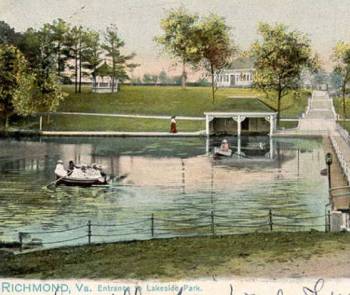

click for larger imageclick for larger image


Amusement parks were created at the end of the lines at Lakeside Park, Westhampton Park (now University of Richmond), and Forest Hill Park. Rails of interurban streetcar services formed a suburban network from Richmond extending north to Ashland and south to Chester, Colonial Heights, Petersburg and Hopewell. Another interurban route ran east along the Nine Mile Road and terminated at the National Cemetery at Seven Pines at the end of the Nine Mile Road, where many Union Civil War dead were interred.


Lakeside Park was different from the other parks. It was financed by one man, and he was not closely connected with the street railway interests. To encourage people to come to the northern suburbs, Lewis Ginter built Lakeside Park with clubhouses, boat houses, bowing alley, a pavilion, a restaurant, and a zoological garden. He constructed a beautiful clubhouse for the Lakeside Wheel Club, a social organization of bicycle enthusiasts who would ride their "wheels" to the club for the day over a cinder path built along a route which would later become Lakeside Avenue.

Ladies could not be members of the club, but they could be extended club privileges if sponsored by a member. Dances were held at the club, as were "turning-out" parties for the season's debutantes. Lakeside Park opened to the public on Sunday, March 15, 1896, and was described in a news story in the Richmond Dispatch the day before:


LAKESIDE PARK OPENING

Public to Be Admitted to the Beautiful Grounds Tomorrow

Lakeside Park, the beautiful new northside resort, situated about five miles from the city, on the Brook Road, will be thrown open to the public tomorrow, and a large crowd is expected to use it. Within the enclosure are two large sheets of water, the clubhouse of the Lakeside bicycle club, a casino, cafe, bowling alley, billiard rooms, deer house, park office, and apartments for officers. The lake which is fed by springs, has been specially stocked with fish, and will be supplied with an abundance of rowboats, and a convenient and speedy two-horsepower naphtha launch. The cafe, billiard rooms, and bowling alleys are beautifully furnished and supplied with the most approved appointments. A large collection of water fowl will grace the lake, and a herd of seven deer will make their home in the grounds.


From Park to Golf...

In the early days of the Depression, Lakeside also began to suffer financially. When the Club almost failed in 1933, the Jefferson Club stepped in to assist the ailing organization. In 1934, the Lakeside Country Club (which had been founded 20 years earlier by a group of golfers from the Jefferson Club) was formally merged with the Jefferson Club to form the "Jefferson-Lakeside Country Club".


CREDITS: Excerpts: Jefferson Lakeside Country Club, Richmond, Virginia