The Mill Mountain Incline,-circa 1920
The Roanoke Valley can lay claim to its share of landmarks. But atop them all is Mill Mountain, a giant hill contained within the city's limits, and capped with an 88-foot neon star.
It's the place of romantic trysts and marriage proposals, picnics and hiking, momentary respites and sweeping views. It's been home to a hotel, a theater and a zoo. And it's where virtually every out-of-town guest is taken first, to "see Roanoke."
What to do with a mountain in the middle of a city? It has been a recurring public issue and remains at issue today. Over the years the mountain has been developed and has remained to see the developments disappear.
Mill Mountain history can be traced to the mid-18th century, when explorer Mark Evans received an English land grant of 87 acres. The plot included a spring where the mountain and valley met, and the mountain was named from a grist- and sawmill built by Evans' son.
In 1890, soon after Roanoke became a city, Roanoke Gas and Water Co. purchased the mountain and the spring, called Crystal Spring, a primary water source for the community.
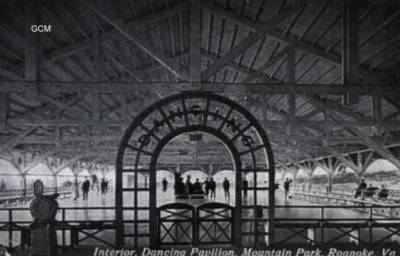
A year later, Roanoke Gas and Water erected a $10,200, 25-room hostelry on the mountain's top. The Rockledge Inn developed a reputation as the area's finest tavern and as a popular vacation spot for eastern Virginians. Shortly thereafter, an amusement park featuring a roller coaster and a pavilion was constructed at the mountain's base.
It was only natural to connect the two attractions, and in 1909, construction began on a cable-car lift called The Mill Mountain Incline. The Incline was a vast improvement over the two-hour walk from the base to the top of the mountain, a vertical climb of 1,000 feet. The 25-cent fare was considered a reasonable investment for the 1,500 who made the round-trip on opening day in 1920.
For nearly 20 years, the two-car apparatus that ran on parallel tracks and was raised and lowered by steel cable thrived -- until a concrete road with twisting, hairpin turns and a criss-crossing loop was built on the front of the mountain. The rise of the automobile doomed the Incline; it was closed in 1929 and dismantled in 1930. But almost 70 years later, the bare strip on the side of the mountain serves as a visible reminder, and continues to spur talk of the Incline's return.
In 1949, the Roanoke Merchants Association spent $25,000 for a large, neon star to be constructed at the mountain's peak. A Christmas advertising gimmick intended to increase trade in the city, the star was featured in Life magazine less than a month after its debut. At the same time, Roanoke's nickname was changed from "The Magic City" to "The Star City."
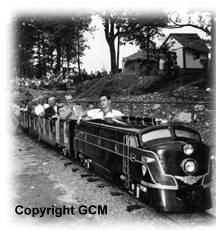
Local civic clubs became heavily involved with the mountain in the 1950s. The Civitans and the Roanoke Jaycees combined with various city departments to build the Mill Mountain Children's Zoo in 1954, and the Jaycees contributed the Zoo Choo, a miniature railroad that circumscribed the zoo.
The Zoo has been a fixture since, with such notable inhabitants as Frump-Frump, an elephant donated by Ringling Brothers and Barnum and Bailey's circus in 1970, and Ruby, a Siberian tiger who lives there today. Frump-Frump, named by a 12-year-old girl in a contest, died of a heart attack 30 years prematurely, and is buried on the mountain.
In 1964, a group of citizens remodeled the dilapidated Rockledge Inn, converting a seldom-used recreation center into a theater featuring live drama. Twelve years later, the structure burned, and Mill Mountain Theatre moved into the valley.
"The Today Show," an NBC staple, has made two broadcasts from Mill Mountain -- in 1958 with host Dave Garroway, and in 1990 with weatherman Willard Scott. Scott's segment featured 30 Miss Virginia contestants and several zoo attractions. "I thought the only place we found emus were in crossword puzzles," Scott cracked.
In 1990, consultants determined that area residents preferred preserving the mountain rather than developing it. The six-month study cost $35,000, involved 475 citizens, and was at least partially responsible for a proposed D-Day Memorial to be scrubbed. The project was dropped because of the anticipated extensive blasting and excavation to the mountain, a course inconsistent with the plan of Fishburn (whose name is attached to a highway spur connecting the back side of the mountain to the Blue Ridge Parkway). And the D-Day Memorial was built in nearby Bedford County.
There are many spectacular views from Mill Mountain. One outlook was named after the late M. Carl Andrews, a former editorial page editor who served as the first chairman of the Mill Mountain Development Committee for nearly 25 years, starting in 1969. Many years earlier, Andrews had worked for Fishburn, and was in sync with Fishburn's vision of the mountain.