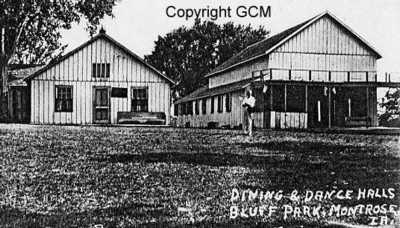
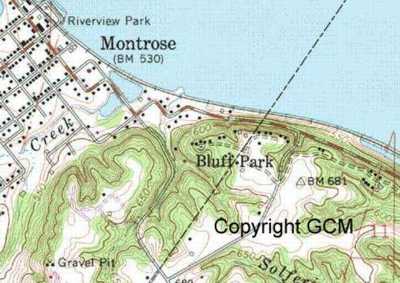
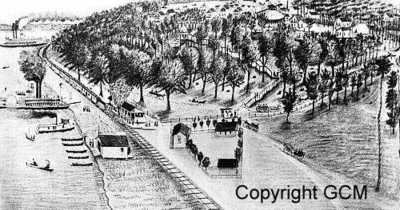
Houses of various vintage and size take advantage of the panoramic river view of the Mississippi River and Nauvoo, Ill., on the opposite shore.
We've been doing some research, said Chatfield, who with her husband, Roger, spends countless hours finding and collecting Montrose history, photos, news clippings and stories.
Montrose once was served by its own train depot and steamboat landing. Bluff Park was full of trees and caught the breezes.
The Methodist Church of Iowa bought the land and there is mention of a tabernacle in 1884, said Chatfield.
The church sponsored camp meetings or revivals, Chautauqua and the main meeting building (or tabernacle) looked similar to a large gazebo or carousel with a permanent roof but open-air sides.
The roads around the bluff were named after biblical places and personalities, such as Jerico Road.
People would come for a Chautauqua and stay overnight in tents.
One fellow we've talked to said his favorite memories were going to Bluff Park for the day. Admission was 10 cents. There was a centrally-located tub of lemonade with a dipper. Folks could drink all the lemonade they wanted for free.
The Chatfields are still in the early stages of finding the history of Bluff Park and its various uses.
They have compiled a loose-leaf notebook with copies of articles written throughout the past century. They have copies of dozens of photos, a pamphlet completed in 1919, Facts About Bluff Park, A Mississippi River Summer Resort, and a 1915 Chautauqua program. The Montrose Library has been a good source, said Mary Sue.
As with other historical research, the Chatfields and MRI welcome any contributions of memorabilia and memories about Bluff Park.
There have been GAR (Grand Army of the Republic - the northerners in the U.S. Civil War) reunions, cottage rentals during the (Keokuk) dam construction and rodeos held at Bluff Park,� said Mary Sue Chatfield.
It has a breathtaking view,� added Roger. �There was a good water supply. An artesian well was up there. We've found different references to its depth, one going as deep as 1,800 feet.
During its time as an amusement park and before the dam was built, there were excursion boats to take people out to small islands offshore. Snag Lake was on one of the islands and people could rent boats to go on the lake. The train ran through Keokuk, stopped at Montrose and went on to Fort Madison and beyond.
Of course, the train also ran south, too.
Articles housed at the MRI museum in Montrose refer to gypsies traveling through near the end of summer and groceries and ice were delivered to residents on the bluffs.
Sheaffer Pen held its annual employee picnic at Bluff Park for a number of years. The park had croquet and tennis courts.
A footbridge used to connect Bluff Park with Lookout Camp across a ravine.