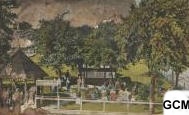
The river bridge connecting the sister towns was completed in 1885, and dedicated by an all-day merry-making, terminated by a dance at the Mason House in the evening. In 1900, William and Frank Mason operated the flour mill by steam, and the town, in a small way, was still considered a manufacturing community, but the dying of industry slowly continued. The Bentonsport Academy had inspired in its pupils the desire for broader fields of action and most of them left the home town.
Thus ends a picture of old Bentonsport. Among those who attend the Homecoming are many who listen for the hoarse whistle of the steamboat and the churn of its paddle wheel. They hear the children shout as the boat comes into port and the groan of rope as it moors to its stanchions. They see the smoke curling from the mills and hear the rumbling mill burrs as the farmers water their teams and visit. When the fiddler tunes up, again they see the Mason ballroom under its kerosene chandeliers, with a merry group all ready to "join hands and circle to the left!"
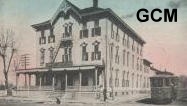
Next to the post office, at the right of the river bridge, stands the Mason House, an early Iowa landmark. This two-and-one-half story brick hotel in modified Georgian architecture was built in the late forties by Billie Robinson. During the flood of 1851 it was struck by a tugboat which took away part of a corner but left it otherwise uninjured. When L. J. Mason and his family came to Bentonsport from New York in 1857, they rented the small Exchange Hotel nearby but, a year later, to accommodate their rapidly increasing patronage, bought the building known then as the "Ashland House." This, as the "Mason House", became famous up and down the Des Moines River as the stop-over for steamboat captains and railroad men. After L. J. Mason's death in 1867, his son George managed the hotel until 1876, when he moved to Des Moines. His sister, Mrs. Clark, then returned to Bentonsport and took charge.
Life was not "all work and no play" at Bentonsport. When the L. J. Mason family arrived in 1857 and took over the Ashland House it soon became a center for social activity. Two generations of the Mason family transformed their hotel dining room into a ballroom and on many a winter evening poignant memories were left with the guests to carry on down the years. When the fiddler, often James C. McCrary, had rosined his bow and tried his A-string until harmony was assured, his rhythm-making heel struck the floor, the fiddle with two bass viols leaped into time and raced into a quadrille tune that quickened the pulses of the dancers. George Mason, a genial host, could call the figures and "taught the ladies how to dance." Besides quadrilles, the schottische, polka, and the sedate waltz were danced and here many a young lady with her dainty french heels and pretty silks, found her lifetime partner.