These needs, as well as the Tri-Cities growing industrialization, led the area to the forefront of public transportation in the nation.
Mass transit began in the Quad-Cities on Oct. 29, 1868, by the Moline and Rock Island Horse Railway Company. They operated their 14-passenger horse-drawn carriages between Moline and Rock Island for a nickel a ride. The route took the horses about half a day, round trip.
But in 1885, the Tri-Cities leapt to the height of technology when Moline began to operate electric street cars. Moline became the first city in Illinois and the third in the nation to do so. Davenport followed suit in 1888 and Rock Island in 1889. In 1889, all three cities street cars were consolidated as the Tri-City Railway Company.
Tri-City Railway street cars were an eye-catching sight on city streets. They measured 44 feet long, 11 feet high, and 9 feet wide. Their wheels were 33 inches high and their front ends jutted out with a metal framework & cow catcher.
They were painted a very noticeable yellow with red trim and they were propelled by a 30 horsepower engine.
During the summer, Tri-City Railway operated smaller, open-air street cars. Passengers hopped on through openings on either side and seated themselves on wooden benches.
97-year-old Lilah Bell grew up off Belmont Road in Bettendorf at a time when the closest schools were in downtown Davenport. In order to get to J.B. Young Intermediate, she had to ride her bike four miles, then leave her bike at a nearby house and catch the streetcar.
I was so young and the street car was so big and impressive. To me, it did not seem like a street car. It was like a train, Bell said.
The street cars filled up every weekday with businessmen and school children. But on the weekends, they needed to find a way to drum up business.
They built amusement parks at the ends of the lines, said Eunice Schlichting, of the Putnam Museum. They needed a way to promote ridership and they made it affordable enough that middle class families could keep coming out.
In the 1890s, amusement parks opened up on Campbells Island, Prospect Park, and Blackhawk State Park on the Illinois side and Suburban Island (now Credit Island) and Schutzen Park on the Iowa side.
Most were modest, with the exception of Black Hawk State Parks Watch Tower on the bluffs which attracted more than 50,000 people a year with rides like The Chute.
I remember The Chute Bell said. They stuck you in this box at the top of the hill and slid you down the track into the Rock River. At the end you were going to get soaking wet no matter what.
Novelties like the amusement parks and downtown Davenports thriving retail sector attracted people from all over eastern Iowa.
So in 1904 the Iowa & Illinois Railway Company began running their powerful electric interurban between Davenport and Clinton. By 1912, the interurban also linked Davenport to Muscatine. The interurban reached speeds of 28 miles per hour.
Beginning at age 7, Bell would have to flag down the interurban to take her to her elementary school, Miss Idas, at Eleventh and Brady Streets.
I still remember the conductors name, Murphy. Every day I would get on and he would pick me up and pretend to throw me off until I screamed and kicked and thought he would really do it. Everyone thought it was pretty funny except me, said Bell. Street cars began disappearing from the Tri-Cities in the 1920s. The automobile and even the bicycle were competition that ultimately proved too formidable.
Though they are long gone, evidence of the growth and development they helped achieve can be seen in the prospering Quad-Cities of today.
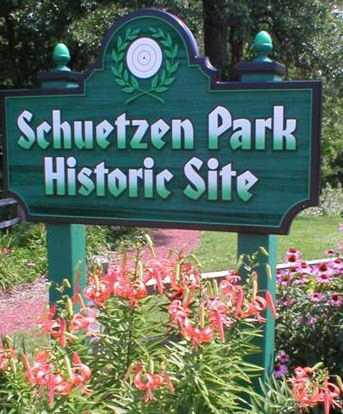
The popularity of Schuetzen Park began to decline around 1917, when the anti-German sentiment from World War I restricted the activities of German-Americans and led to the prohibition of the use of the German language in public. Many businesses and organizations changed their German names. For a time, Schuetzen Park was renamed Forest Park. The Davenport Schuetzen Verein became known by its English equivalent, the Davenport Shooting Association.
The park was dealt another serious blow in 1919 when the "Prohibition Act" outlawed the manufacture and sale of alcoholic beverages, which had been a major source of revenue for the park. The park was sold in 1923, and it became the site of the Chiropractic Psychopathic Sanitarium. The Davenport Shooting Association continued to use the park for many years after the 1923 sale. However, today, the Association has a new range in Scott County near Princeton. In 1960, much of the property again changed hands to the Davenport Good Samaritan Center.
Today, what remains of this special site is being preserved as a "Wildpark." The only original park building that remains is the 1911 street car waiting station, which was named a local historic landmark in 1998 by the City of Davenport.