Belle Isle became a park, and bath houses were added for swimming before World War I. The firm added an amusement park with thrill rides and a carrousel in 1922 to build ridership, and L.E. Buttrick developed a dance pavilion on the island.
With the pavilion, a boardwalk, "Honey Moon Bridge" and canoe rides, Belle Isle became a favorite place on summer evenings for young couples, including my parents. For Fourth of July celebrations, the great Houdini and stunt divers attracted thousands of people to Belle Isle. Now, nearly 70 years after the amusement park faded away and more than a decide since the lake was drained, a new era is envisioned for Belle Isle. Sapphire Properties of Dallas and Coon Engineering of Oklahoma City announced in February they were planning commercial development with 500,000 square feet of retail space, and the project is moving forward. The city will extend Classen Boulevard north of Interstate 44 to connect with the northern segment of Classen, which extends from NW 63rd Street to Britton Road. Renting swim suits for 35 cents While these plans could result in a new shopping area and new traffic patterns, they actually are bringing Oklahoma City's past into the future in a way that is remindful of Bricktown.
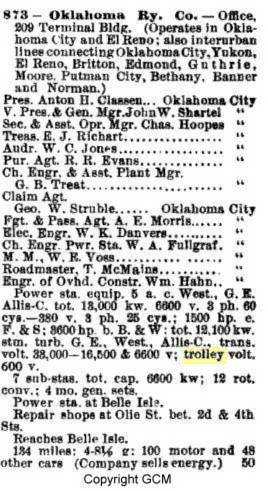
So let's take a look at the heritage of Belle Isle. The Oklahoma Railway Co., headed by President Anton Classen and Vice President John W. Shartel, built a Belle Isle generating plant in 1907-08 at the end of the Classen street car line. Boating, fishing and picnicking were allowed free on the lake, which was formed by damming the Deep Fork River. Putnam Lake also existed near Classen Boulevard between NW 34th Street and NW 36th Street at that time. That lake was drained in about 1908 to form Memorial Park and encourage residential development. Homes, of course, would provide a growing market for street cars. The street car line was extended as an interurban line from Belle Isle Lake north, then east across Western Avenue (on what later became the "Graffiti Bridge"), and north on the northern segment of Classen Boulevard. It reached Guthrie in 1916. In 1984, I talked to Vice President Bill Wolfe of Oklahoma Gas & Electric Co., Bruce Rey and Isadore S'renco.
Wolfe and Bruce Rey both grew up near Belle Isle, and S'renco recalled numerous events there. "There even was a small zoo at Belle Isle at one time," Rey told me. "I remember a deer, a tiger, a bear, ducks and swans. There was a boat dock and a canoe club. The old bath house was on a clean lagoon with a sandy beach for swimming. In the winter, I would stop at the coal-fired generating plant to warm up on the way to school at NW 63rd and Western Avenue." Wolfe went to work at Belle Isle before World War I and continued for 13 summers. He remembered swim suits renting for 35 cents each.
With the development of the amusement park in 1922 came major attractions for summer holidays. S'renco recalled seeing Houdini perform before thousands of people. "They chained Houdini into a box and dumped him into the lake," S'renco told me. "He escaped from the box and came up from the bottom of the lake." S'renco also recalled the
classic carousel, or merry- go-round, which was patterned after the one at New York's Coney Island with the opportunity to grab a legendary "brass ring" for a free ride. "There were 15 to 30 galvanized rings and one brass ring," S'renco said. "People on the carousel would reach out and grab the rings. The lucky person got the brass ring and another ride. That led to the expression: `reach for the brass ring.'"
Knee deep in mud Wolfe and Rey both saw stuntman Tip Shears jump from an airplane into Belle Isle Lake as part of a Fourth of July show. It happened in about 1924 or 1925, when Wolfe was a lifeguard. Shears was billed as the "Only Man to Jump Out of an Airplane and Live," but Wolfe turned out to be the hero. "The two-winged airplane came over the pavilion on the island with Shears hanging from the wheels," Wolfe told me. "He dropped feet first about 20 feet into about 12 feet of water. I was in a boat at the time. As soon as he dropped, I went for the spot where he hit the water. "When he didn't come up, I dived into the water. I couldn't see him, but on my first swing, my arm caught his arm, and I pulled him up. He had been stuck in mud up to his knees." Meanwhile, Buttrick promoted Buttrick School of Dancing at the pavilion. He featured bands such as Speedy Walker and the Gloom Chasers, Tackett's Toe Teasers, Harry Steinburg and T. Holder. Out of the Tackett band came Bonnie Spencer, who led one of the city's favorite bands of the 1940s and 1950s.
In 1928, Oklahoma Railway Co. sold the power plant, park and lake to Oklahoma Gas and Electric Co., which built a new plant. The amusement park was closed, and the carousel burned, but the interurban line to Guthrie continued until 1946. The Classen line street cars turned around at Belle Isle Lake until 1947.
Leadership Properties planned a revival of Belle Isle in 1984 with 40,000 square feet of retail space plus offices, a hotel, a boardwalk and possible use of the old generating plant as a banquet facility. The firm purchased a 1903 carousel, for the island, and there was even talk of connecting Belle Isle with Penn Square Mall with boat rides. That dream faded with the real estate slump of the 1980s, but Penn Square Mall adopted a boardwalk theme for its $100 million renovation. Now, a new dream is emerging. Perhaps, some day, we will stroll and shop along Belle Isle Lake on summer evenings -- maybe even cross Honey Moon Bridge -- as our parents and grandparents did in that quiet, slower time of years ago.