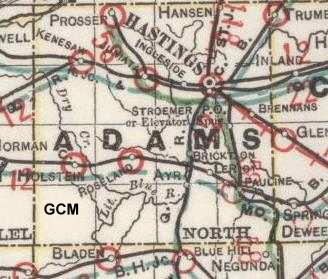
These places could be 2 different places but until more information I will list them on same page. Dyer's Mills and Crystal Lake. --in a very rural area.....
Before the project was complete in 1875, Elbridge and True Dyer joined their uncle as partners. The lumber used to construct the mill was hauled from Inland and the large mill stones were brought from Juniata, which at that time was the end of the Burlington railroad line. This early settlement was called Millington.
In 1876 W. Klingman built a cheese factory in Millington. In 1879 this factory manufactured 26,000 pounds of cheese. A store was built and operated for a short time, but in 1880 this business was moved to Ayr by Keith and Kress.
The settlement continued to prosper: In 1887 when the K.C. and O. Railroad reached the area, a depot was moved from the junction one and one half miles north of Ayr. A store was built that year by John Marshall and John A. Frank. A post office was established in this store, with Mr. Marshall serving as the first postmaster. It was at this time that the name of the community was changed to Leroy named for Leroy Stone, whose father Charles Stone was a substantial stockholder in the railroad.
This was the boom period for the tiny village. The water-powered mill with its three runs of burrs was kept busy as farmers from miles around brought their wheat to be ground into flour. An elevator was built, along with a blacksmith shop and livery stable. In 1881, a school building was moved from a site about one mile north, where it had stood originally, and was used as a church by the Presbyterians. During these years Leroy was an active trading center; settlers brought their grain to be processed at the mill, and secured machinery, repairs and the simple necessities at the store.
The Dyer brothers continued to operate the mill until 1905, when high water destroyed the dam. The popularity of Leroy as a recreational area began to wane. The Dance Pavilion burned in 1937-1938, along with what remained of the old mill. Business and Population, listed at 76 in 1910, declined steadily, and the village eventually became only a pleasant memory of the early history of Adams County.
In 1893 the Crystal Ice Company dammed a portion of the Little Blue River 1 1/4 miles north of Ayr, creating "Crystal Lake" for harvesting and selling ice. A huge storage and loading facility was built on the nearby Republican Valley branch of the Burlington Railroad. Horse-drawn scoring knives and long, back breaking ice saws, later replaced by power saws, cut the 16" thick ice into 9'2" squares, which were floated down a channel to be cut into twenty-five, 22" x 22" cakes. Ten thousand tons per season was the capacity. A large ice house was filled for the Hastings trade, and hundreds of carloads were sold to the railroad. This winter ice harvest provided a thirty-day income for as many as fifty workers.
In the 1920s mechanical refrigeration ended the ice business and Crystal Lake became a private recreation area for picnics, dancing, swimming, boating, fishing, and skating. In 1937 the 63-acre site was purchased by the state and improved by the WPA. Silt eventually filled the lake, and in 1976 a $180,818 renovation of the lake and park was a project of the Ayr Bicentennial Committee. Crystal Lake State Recreation Area is part of the Nebraska Game and Parks Commission system.