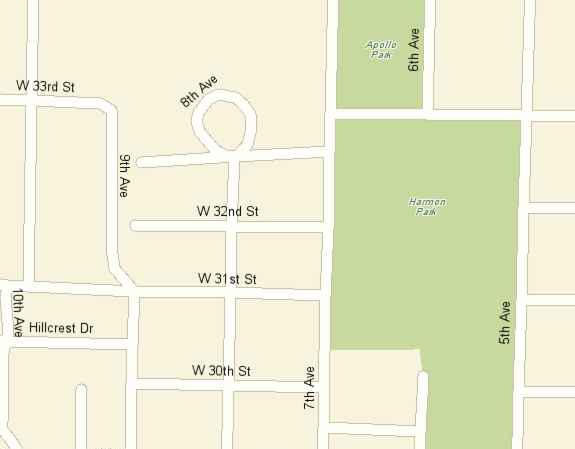
The oldest portion of the park, the block between 5th and 6th Avenues and 29th and 30th Streets, dates back to August 7, 1876, when it was given to the city by Thomas Perkins and James Harford "for the sole and only purpose of a public park for the use and benefit of the inhabitants of said city," according to the deed. It was later dubbed Third Ward Park, and so designated for many years.
Beautiful trees, grass and flowers, some sidewalks, a couple of drinking fountains and a few benches were all this park could boast in the early years when its location was near the north edge of the residential section of the city. There was never a bandshell, and there were no picnic tables or playground equipment. Probably some summer church services were held. The name of this park area was later changed to Lincoln Park.
When tent Chautauqua was organized for summer entertainment in Kearney in 1907, the block north of Third Ward Park was acquired by the city for Chautauqua grounds, and from 1907 until 1924 this section of the park was named Chautauqua Park. Beyond these grounds to the north were acres of farm and pasture lands.
In 1924 William E. Harmon of New York City organized the Harmon Foundation for the purpose of lending financial assistance to communities wishing to open playgrounds. Esther Stock Kroeger, secretary of the Kearney Chamber of Commerce, heard of this, and with the acquiescence and assistance of Chamber president Ray E. Turner, made application for a grant from the Harmon Foundation. Fifty communities of the nation would receive funds to secure fields for playgrounds. 784 towns applied.; Kearney was one of the fifty lucky recipients.
The Harmon Foundation donated $2,000.00 to the city to purchase fourteen acres. The cost was $2,640.00 and the city put up the extra $640.00. The land purchased was the four-block area between 31st and 33rd Streets, and between 5th and 7th Avenues. Later the city would also purchased the half block between Park school grounds and 31st Street, making the park six and one-half blocks in size, and so it remains today. The four-block area purchased by the Harmon gift was designated Harmon Field. This was a stipulation in the deed. For five years the park was required to operate under this and other stipulations laid down by the Harmon Foundation. A marker in the park commemorating the gift reads:
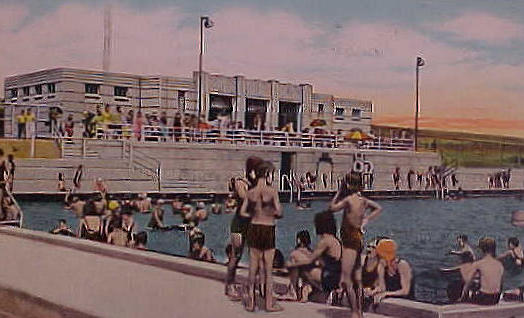
Swimming Pool and Bathhouse - Opened June 1937.
Community interest was high. The Kiwanis Club provided a wading pool for children, the Cosmopolitan Club constructed three tennis courts, and the Rotary Club and other civic organizations, as well as individuals, made cash donations or equipment contributions. The Kearney Woman's Club placed the first picnic tables in the park.
Mrs. Bud Merryman recalls that her father, Bill Cave, was the first park policeman, appointed in 1926 at a salary of $75.00 a month. In addition to his police duties, he supervised the installation of the first playground equipment in the park, which included a
double slide, merry-go-round, ocean wave and traveling ladder.
Next to this area in the center of the park was the playground, north of which were monkey cages, later used for squirrels, pigeons and similar small animals and further north was a corral for about 14 ponies. "I was one of the lucky children who took care of these ponies," says Mrs. Lynch, "and it was a highlight of my childhood. The ponies were owned by the city and were taken care of by the Barklund family whose farm was located at 33rd Street and 4th Avenue. We took the ponies to the park at 9:00 a.m., back to their barn at the farm about 11:00, then back to the park from 1:30 to 4:00, and again in the evening from 7:00 to 8:30. The rides were offered to children every weekday and on Sunday afternoons.
The period of the 1930's was one of financial depression when the heat, drought and grasshoppers seemed almost too much to bear. The development of Harmon Field must have been a symbol of hope because in spite of the difficult times, the people of Kearney in 1936 voted in favor of a local bond issue of $35,000 to construct a swimming pool and bathhouse on the west side of Harmon Field. Plans for a modern, up-to-date swimming pool, 160 feet long and 82 1/2 feet wide, with bathhouse, were drawn up by Architects McClure and Walker. However, the project was held up before contracts were let when it was learned that the city might be eligible for a federal PWA (Public Works Administration) grant which would provide a more comprehensive park project. On June 15, 1936, a grant of $28,600 was applied for.
On the occasion of its dedication on June 21, 1938, the Kearney Daily Hub describes the structure and its equipment: "Kearney's new Sonotorium--was formally dedicated at a program last evening which drew thousands of spectators to Harmon Field park. 'Sonotorium' is a newly-coined word. The structure is an open-air theater with a broad, sixty-foot open air stage, flanked on either side by tall concrete towers and spreading concrete wings which house an electric sound system capable of being heard for any distance from a few feet up to a mile or two."
This very advanced speaker system was built by the Keller Radio Service of Kearney, and involved highly technical equipment. The east pylon of the Sonotorium where the set was located was full of wires, plugs, knobs and instrument boards. At the dedication program, Ward Minor, Kearney attorney, gave a brief talk eulogizing Stanley Keller, who designed and built the system, and also praised the work of Keller's assistant, Dale Boucher. Mr. Keller had died before the system was installed, but the installation and operation of the elaborate sound system was carried on by Dale Boucher at the dedication and for some time thereafter.
A new electric organ funded by the Junior Chamber of Commerce was installed for the dedication and played by LoDesca Miller. Federal and state PWA, WPA and NYA officials were on hand. Mayor D. Wort expressed thanks to Architects, McClure and Walker, and to the park commissioners. The national anthem, played on the organ, marked the end of the dedication. Programs at the Sonotorium have since been a summer tradition.
The confusion and uncertainty of the park names was cleared up by action of the City Council on April 17, 1939, by which "Harmon Field and Lincoln Park, immediately adjacent to each other, shall be designated as Harmon Park."
In descriptions of the many park improvement projects at Harmon Field, no mention was ever made of the lighthouse, and no clue as to when it was built. The answer was found in the May 6, 1940 issue of the Kearney Daily Hub, in an article setting out the upcoming summer season at the park:
Stone is on the ground for the erection of a lighthouse overlooking a portion of the rock garden. It will have a rounding stair. Construction is expected to be under way within 10 days. Incidentally, rocks from the first school, first courthouse and first city hall in Kearney have been used in the rock garden.
A Youth Center was completed on Harmon Park grounds in August of 1951. Two barracks buildings from the Kearney Air Base were moved into the park, improved and remodeled. Its popularity as a youth center declined in the late 1960's, and the building now houses the Harmon Activities Center.
In addition to the larger projects, the park has offered lighted tennis courts, ballgames of every variety - hard ball, soft ball, kitten ball, Little League ball - badminton, soccer, volleyball, and facilities for playing croquet, roquet, horseshoes, shuffleboard and other popular games.
Today the park remains relatively unchanged. It is operated along with other city parks by the Kearney Park and Recreation Department, with direction from a Park Advisory Board of seven members appointed by the City Council. It is a drawing attraction for citizens of Kearney and for out-of-town visitors alike, as they picnic, seek recreation, gather for reunions, enjoy programs at the Sonotorium or browse through the rock garden. With the current improvement projects for a new swimming pool, renovated bathhouse and an upgrading of the entire park, the people of Kearney continue to dedicate Harmon Park "forever to the plays of children, the development of youth and the recreation of all."