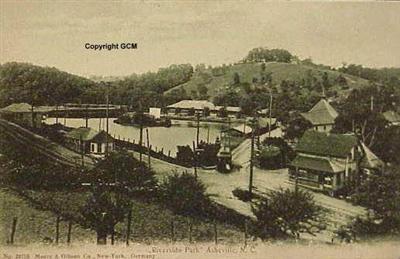
How could I not include Asheville? Virtually all Trolley Companies set up Amusement Parks to increase ridership and not one in Ashville? There were almost endless fashionable Resorts which by odds had some 'amusements' at one time or another so if this page be just for them....


click for larger imageclick for larger image


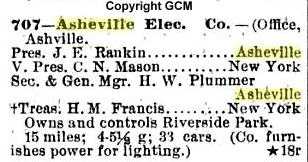
ok....for #1....Asheville's Riverside Park, located on the French Broad, was the state's only such park with a river setting. While the water provided a scenic outlook, it and the flood of 1916 destroyed the park as well as many of the city's streetcars.


#2-It would seem there was a park(s) in Sulfur Springs. Asheville area. I have no further information at this time. If it was just a 'Hot Spring' Mineral Water' location I will not include it. As in many states 'water' was an attraction and 'grand hotels' popped up around such. It would take a whole web site in itself to document such.

#3-There was Overlook Park which has a seperate listing. CLICK HERE


The area is very confusing as there were endless Resort Hotels. Without more research I can not guess how many 'Amusement' Parks existed in this area in the grand days of the Resort Hotels and Trolley Lines. I have isolated three which seem to be specific 'Amusement Park' but this area is still open for research.


--- just excerpts...I've been through hundreds of pages.....

Asheville was an isolated mountain town for many decades. But when railroads finally reached the community from Salisbury in 1880 and from Spartanburg in 1886, Asheville grew as a tourist and health resort. But the two-mile trip from the depot to downtown was still a challenge. This journey required climbing hills with a ten and a half-percent grade, too steep for horsecar operation and too expensive for a cable system.

E. D. Davidson of Long Island, New York, who had financed a horsecar system in Halifax in eastern Canada, came to Asheville in early 1888 to explore opportunities. The city of Asheville authorized a charter for an electric railway that would include lines from Pack Square to various sections of the city, including the depot that served the Western North Carolina Railroad (which ran east to Salisbury). Davidson agreed to build the system in close collaboration with Frank Sprague, builder of the Richmond system. John Barnard helped supervise construction and became the company's general manager. The line to the depot opened on February 1, 1889. From the Public Square (now Pack Square), the line extended down South Main Street (present Biltmore Avenue) and Southside Avenue, and then was routed onto Depot Street (west of present-day McDowell Street) to the depot, which was located on flat land in the railroad yard (a half-mile west of Biltmore Village). Ida Briggs Henderson, an eyewitness to the opening events, remembered the excitement: "I can still recall the applause that was given by the people who stood along the sidewalks, watching the demonstration which took place on that day."

Various railway companies organized and built lines to emerging neighborhoods north of downtown; to outlying areas, including the Sulphur Springs resort west of the city; and to Biltmore Village, a town near the emerging Biltmore estate. In 1907 Asheville led the state by carrying three million streetcar passengers (total number of trips by riders), compared to Charlotte and Wilmington with two million each. By 1915 the street railway reached its maximum size, operating forty-three rail cars on eighteen miles of track, including one to the newly opened Grove Park Inn. The streetcar system continued to serve Asheville's tourists and growing population, which reached 28,000 in 1920 and 50,000 in 1930.

Thomas Wolfe, the noted novelist who grew up in Asheville, described the city's streetcars in one of his short stories. "The street-cars ground into the Square from every portion of the town's small compass and halted briefly like wound toys in their old quarter-hourly formula of assembled Eight."

In 1900 most of the city's railways were consolidated into the Asheville Electric Company, the utility furnishing electricity to the city. Although the majority of directors and officers were from Asheville, James H. Cutler of Boston, an agent for General Electric Company, was a major investor in the company. Asheville Electric became Asheville Power and Light Company in 1912, with the majority of the directors at that time coming from New York. In 1926 the company was sold to Raleigh-based Carolina Power and Light Company (now Progress Energy)

ASHEVILLE SULPHUR SPRINGS. On the last day of February 1827, Robert Henry and his slave Sam discovered this spring five miles west of Asheville, and about the year 1830 his son-in-law, Col. Reuben Deaver, built a wooden hotel on the hill above and began taking summer boarders. Such was the patronage that an addition had to be made to the hotel every year. As many as five hundred are said to have been there at one time, and the neighborhood was ransacked for beds, bedding, chairs, and provisions. Most of the visitors came from South Carolina, among whom were the Pinckneys, Elmores, Butlers, Pickenses, Prestons, Alstons, Kerrisons, and others. Mr. John Keitt was the first person buried on Sulphur Springs hill, August 27, 1836. The fact that the Pinckneys were almost constant visitors accounts for the prevalence of the given name Pink in the neighborhood of Asheville. The Aistons reserved the corner rooms on the second floor from May till frost every season. Besides the hotel, an L-shaped building, there were cabins on the grounds. There were bowling alleys, billiard tables, shuffle-boards and other games. A large ball-room and a string band, composed of free negroes from Charleston and Columbia, provided the music for dancing. One of these negroes was named Randall, who had been presented with a purse of $5,000 by the white peop1e of South Carolina for having given information about a contemplated negro insurrection at Charleston; and another of these musicians was named Lapitude, who owned a tation near Charleston and forty slaves. He was a man of some education, and the manner of a Chesterfield. From its opening till 1860 there were more summer visitors at Deaver's Springs than in Asheville. Col. James M. Ray gives us this picture of Asheville sixty years ago: "Well, what of Asheville in these long past years? It was about like Leicester or Marshall-a very small village on the 'turnpike,' midway between the two Greenvilles. The two 'hotels', Eagle and Buck, even many years later, not doing near the business of many of the country inns or stock stands on the Warm Springs road. For anyone to stop at either of these two hotels longer than for dinner or for the night was not thought of; though a few summer visitors would sometimes make a short stop in passing through to Deaver's Springs or to Warm Springs, Wade Hampton and others with fast teams driving from Asheville to Warm Springs for dinner. "The old hotel was burned in December, 1862, was rebuilt by E. G. Carrier-of brick this time-in 1887, and known, first as Carrier's Springs and then as The Belmont. It was again burned in September, 1891, while under the management of Dr. Carl Von Ruck. From 1889 till 1894 an electric railway ran from Asheville to the spring, but it was abandoned.


WEST ASHEVILLE. In 1885 Mr. Edwin G. Carrier and family moved to Asheville from Michigan. He soon afterwards bought several hundred acres of land west of the French Broad river, including the Sulphur Springs and the J. P. Gaston tracts of land. In 1887 he built a large brick hotel on the site of the wooden structure that was burned during the Civil War, and soon thereafter, 1891, constructed an electric railway from Asheville to Sulphur Springs, crossing the French Broad river near the mouth of the Swannanoa on a fine steel bridge. This railway first ran ouly to the passenger station; but, on October 13, 1891, it was granted a franchise by the city to extend its line through Depot street, Bartlett street and French Broad avenue to the corner of West College and North Main streets. It stopped, however, at what is now the corner of Haywood street and Battery Park Place, then called Government street. It was called the West Asheville and Sulphur Springs Railway Company.

A race track was established just south of Strawberry Hill and between the Sulphur Springs railway and French Broad river. A grand-stand was erected and a high fence built around the race track. There were several exciting races all of which were well attended.


CREDITS: Excerpts: Charlotte-Mecklenburg Historical Landmarks Commission-City of Asheville, North Carolina