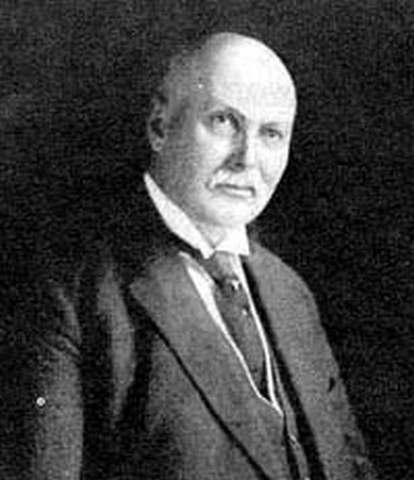
In 1883 he started the Charlotte Trouser Co. in Uptown Charlotte. Met Thomas Edison in 1890 who convinced him to go in the real estate business and establish an electric streetcar line in Charlotte.
Dilworth was Charlotte's first streetcar suburb. Opened on May 20, 1891. Trolley service began the same day.
There were no automobiles in Charlotte in 1891.
The trolley goes through the industrial district of Dilworth.

Trolley line built by Edison Electric Company for $40,000.
Wilmore established in 1914 by developer F. C. Abbott. Made up of two farms, one belonging to the Wilson family and one to the Moore family. That's why it is called Wilmore. East Boulevard and Park Ave. were extended across railroad track to connect Dilworth and Wilmore. Wilmore was also served by a trolley line running south on Mint St. from Uptown.
Made In The Carolinas Exhibition Building
Built in 1923 as part of Made In The Carolinas Industrial Exposition.
Used to display industrial products made in North and South Carolina.
Thousands rode train to visit the site.
Governors of North Carolina and South Carolina were at official opening ceremonies.
Band from Russia came to perform.
Later the building was converted into an A&P Grocery Store.
First streetcars in Charlotte were horse-drawn. Began operating on January 3, 1887.
Electric streetcars or trolleys began operating on May 20, 1891.
Trolley Line was taken over by Southern Power Company (later the Southern Public Utilities Company and Duke Power) in 1911. Ran to neighborhoods like Dilworth, Myers Park, Elizabeth, Wilmore, Piedmont Park, Belmont-Villa Heights, Biddleville and Washington Heights.
Site of violent strike in 1919. Company officials occupied the carbarn and were attacked by strikers. There were deaths. Streetcars quit running in March 1938. This became the bus barn.
Charlotte Trouser Co./Lance Building
Charlote Trouser Co. moved to Dilworth from Uptown Charlotte in 1894.
Second oldest factory building in Dilworth. The Atherton Mill is the oldest.
Manufactured men's trousers for distribution throughout the country.
Company founded by Edward Dilworth Latta, but he had sold it by time it moved to Dilworth.
Later occupied and expanded by Lance Packing Company. Old Charlotteans remember smelling roasting peanuts as they drove up South Boulevard.
Converted into condominiums.
Park Manufacturing Company Building Site (Burned February 1997. Destroyed June 1998) Built in 1895 and expanded in 1901. Manufactured pumps, heaters and primarily elevators.
One of six factories that opened in Dilworth in 1895.
Park Elevator Company vacated in 1980's.
Became a night club. Hootie and the Blowfish performed here.
Bland St. is named for Dr. Charles Alberto Bland. He was one of Edward Dilworth Latta's partners in developing Dilworth and establishing the trolley line.
Carson Blvd. is named for the Carson family, who owned and operated two gold mines in the area.
Until 1891, there was no bridge carrying Morehead St. over the railroad track. Morehead St. is named for John Motley Morehead, who was a leader in promoting railroad construction in North Carolina. The Morehead Scholarships at UNC Chapel Hill are named for him.
Tobacco and textile manufacturer James B. Duke established a new utility, Southern Power Company, in Charlotte in 1905 and began building hydroelectric plants along the Catawba River and the Piedmont region. The company won approval for a streetcar franchise in 1910, despite opposition from Latta.
Shortly thereafter Latta sold his trolley company, Charlotte Electric Railway Company, (consisting of thirteen miles of tracks, thirty-nine trolley cars, and a car barn), to Southern Power for $1,235,000. At the same time, Latta sold Duke his gas supply business.
Southern Power, at Duke's initiative, also established the Piedmont and Northern Railway in 1911, the state's only successful interurban electric railway and one of a few such systems in the Southeast. The Greater Charlotte Club (now Charlotte Chamber of Commerce) supported this move by raising and contributing $300,000. Interurban lines operated between cities, also accessing electricity overhead, but using multi-car trains that served freight as well as passengers. P&N's Charlotte-Gastonia line opened in 1912 with its own tracks and included passenger stops in Pinoca, Thrift, Mount Holly, North Belmont, McAdenville, Lowell, Ranlo, and Groves. The railroad also operated a passenger and freight line between Spartanburg and Anderson, S.C. and an all-freight line from Mount Holly to Terrell, N.C. in Catawba County.
In 1913 Southern Power (which became Duke Power in 1924) organized a new subsidiary, Southern Public Utilities Company, to operate streetcar systems and expand the company's retail activities. The following year, the company opened a new, forty-car barn. By 1930 Duke Power owned the streetcar systems in Winston-Salem, Greensboro, High Point, and Salisbury. The Charlotte system expanded to serve several new outlying neighborhoods and reached a total of twenty-nine miles of trackage.
On July 9, 1910, Latta opened Lakewood Park, so that he could dismantle nearly all of Latta Park to provide more residential land for Dilworth. Located on the streetcar line just outside the city limits on the northwest side, Lakewood Park featured amusement rides, including a roller coaster which cost $15,000 and a 100-seat merry-go-round, as well as a lake for rowing and swimming, a zoo, and a dancing pavilion. Latta leased Lakewood to Southern Public Utilities before selling it to the company in 1916 for $50,000. The parents of Billy Graham met while attending a picnic in the new park. Lakewood Park developed a tradition of extending its season an extra week in the fall for African-Americans.