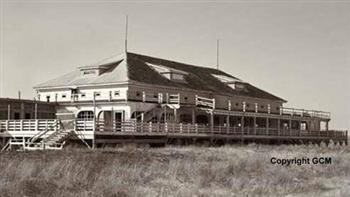
I do not know how to document 'amusement parks and other trivia' of this area except list such if information is found.
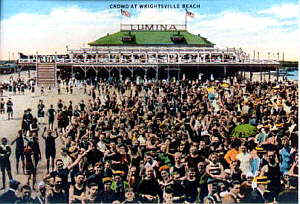
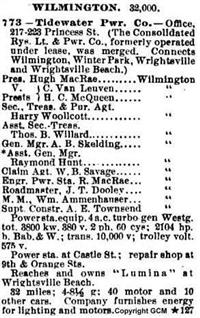
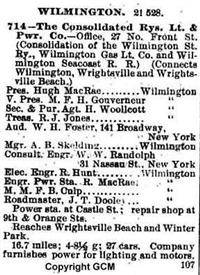
The Railroad/Trolley did build their big Pavilion there- THE LUMINA -- and it survived until the 1970's. (although maybe re-built many times) The reference on 'trolley notes' in image mentions Winter Park. It is unknown whether this was a Trolley Amusement Park or a suburban housing development.
In 1902 Hugh MacRae of Wilmington formed Consolidated Railways, Light and Power Company, and purchased the city's street railways, light, and power facilities. He had already established a company to generate electricity near Rockingham on the Pee Dee River. In 1907 MacRae strengthened his holdings by forming Tide Water Power Company, retaining ownership of the streetcar system.
MacRae converted the Wilmington-Wrightsville Beach line into an electric system and consolidated the county's two rail systems. Instead of starting their trips at a station at Ninth and Orange Streets, a mile from downtown, beach passengers began boarding downtown. The city's lines were extended to accommodate growth of suburbs on the city's northern edge. Equally significant was the opportunity for trolleys to encourage new neighborhoods along the beach route. Whereas the steam train probably had no stops, the electric streetcar eventually served a total of twenty waiting stations. These stations, one of which has survived, consisted of attractive, small concrete shelters. In 1905 MacRae opened Lumina, a pavilion located on the ocean at the last southern trolley stop at Wrightsville Beach. Name bands played for dancing, and movies were shown. Automobiles were not allowed on Wrightsville Beach until the mid-1930s.
In summary, Asheville, Winston, Charlotte, Raleigh, and Wilmington established electric streetcar systems during the 1889-1892 period. The next phase of North Carolina's streetcar development occurred in the first decade of the twentieth century, when private companies built systems in Greensboro, Durham, and Salisbury that operated until the 1930s.
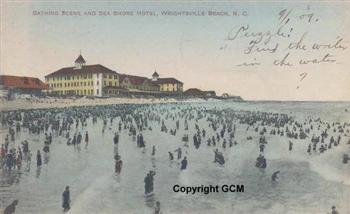
Originally known as New Hanover Banks or Ocean View, early developers envisioned the community as the Atlantic City of the South. Somewhat less sophisticated in those days, an 1897 meeting of property owners proposed an ordinance to prohibit cattle running loose. Today, aside from restaurant fare, no trace of cattle can be found.
The trolley began operating in 1902, replacing an older railway train. The route roughly paralleled the "shell road" (now Wrightsville Avenue) and ran along today's Park Avenue, where a couple of the old station shelters still remain. Operated by the Tidewater Power Company, the trolley cars were orange with cream trim, carried 68 passengers each, and made the trip from downtown to the beach in as little as 35 minutes. Five-car trains ran during the height of the season.
In 1903, the Tidewater Power Company purchased an oceanfront lot for $10 at Station 7, the end of the line, where it built the Lumina Pavilion, named for the thousands of incandescent lights that made the building visible from far out at sea. Constructed entirely of heart pine, it was opened on June 3, 1905, and underwent two major expansions in subsequent years.
The pavilion featured a vast promenade, bowling lanes, a ladies' parlor, an upstairs restaurant and downstairs lunch service, dressing rooms, slot machines and other amusements, but the gem of the pavilion was its second-floor dance hall. The enormous dance floor accommodated hundreds of dancers, and the high-ceilinged room was festooned with bunting and flags. Some of the era's most famous orchestras and big bands played there, including Kay Kaiser, Guy Lombardo, Cab Calloway Tommy Dorsey, Paul Whiteman and Stan Kenton. (Wilmington was the biggest city in North Carolina at the time.) Curiously, a writer in 1910 recalled that opera was favored by Lumina audiences over so-called popular music of the day.
Other attractions included dance contests, beauty pageants, beach games such as sack races and water sports, and convention dances. Swimmers could rent bathing suits emblazoned with "Lumina" on the front. An especially unusual attraction was motion pictures. The owners erected a screen about 50 yards into the surf and projected silent movies that could be viewed from seating on the beach or from the promenade. The screen was moved closer when "talkies" appeared. This tradition lives on in the annual Lumina Daze celebration, which benefits the Wrightsville Beach Museum of History.
Admission was free before World War I. After that, the trolley to the beach cost 35�, which included admission to the Lumina.
The trolley line even influenced the birth of Wilmington's early suburbs -- Carolina Place, Carolina Heights, Oleander, Audubon, and Winter Park grew up along the route. Then, in the 1930s, the first automobile route was built to Harbor Island. Billboards sprung up: "In a hurry? Take the Causeway." It wasn't long before the road spanned Banks Channel, and another road was paved down the length of the island in 1935. Soon the trolley became a throwback to a more sluggish era, and it declined in popularity. Its last run took place April 27, 1940. The only beach car alleged to remain today is in Annabelle's Restaurant on Oleander Drive.
The Lumina remained viable a while longer. Hot dogs and surf accessories were sold downstairs. Rock concerts were occasionally held there in the 1960s, but by the early '70s the ballroom stood perpetually dark, and in 1973 the pavilion was torn down. The Lumina lives on in many place names around the beach and, like the old Oceanic Hotel and the Harbor Island Casino, it won't be totally forgotten any time soon. The Lumina and the beach trolley are reminders that perhaps being in a hurry really isn't what the beach is all about.
Originally known as New Hanover Banks or Ocean View, early developers envisioned the community as the Atlantic City of the South. Somewhat less sophisticated in those days, an 1897 meeting of property owners proposed an ordinance to prohibit cattle running loose. Today, aside from restaurant fare, no trace of cattle can be found.
The trolley began operating in 1902, replacing an older railway train. The route roughly paralleled the "shell road" (now Wrightsville Avenue) and ran along today's Park Avenue, where a couple of the old station shelters still remain. Operated by the Tidewater Power Company, the trolley cars were orange with cream trim, carried 68 passengers each, and made the trip from downtown to the beach in as little as 35 minutes. Five-car trains ran during the height of the season.
In 1903, the Tidewater Power Company purchased an oceanfront lot for $10 at Station 7, the end of the line, where it built the Lumina Pavilion, named for the thousands of incandescent lights that made the building visible from far out at sea. Constructed entirely of heart pine, it was opened on June 3, 1905, and underwent two major expansions in subsequent years. The pavilion featured a vast promenade, bowling lanes, a ladies' parlor, an upstairs restaurant and downstairs lunch service, dressing rooms, slot machines and other amusements, but the gem of the pavilion was its second-floor dance hall. The enormous dance floor accommodated hundreds of dancers, and the high-ceilinged room was festooned with bunting and flags. Some of the era's most famous orchestras and big bands played there, including Kay Kaiser, Guy Lombardo, Cab Calloway, Tommy Dorsey, Paul Whiteman and Stan Kenton. (Wilmington was the biggest city in North Carolina at the time.)
Curiously, a writer in 1910 recalled that opera was favored by Lumina audiences over so-called popular music of the day. Other attractions included dance contests, beauty pageants, beach games such as sack races and water sports, and convention dances. Swimmers could rent bathing suits emblazoned with "Lumina" on the front. An especially unusual attraction was motion pictures. The owners erected a screen about 50 yards into the surf and projected silent movies that could be viewed from seating on the beach or from the promenade. The screen was moved closer when "talkies" appeared.
Manners were carefully observed at the Lumina. Jacket and tie were essential. Cheek-to-cheek dancing? Unacceptable! Mrs. Bessie Martin, the Lumina's permanent chaperon, saw to that. No alcoholic beverages or rude behavior were permitted, either Tuck Savage saw to that. Some called Tuck a "supervisor"; today we'd call him a bouncer. Admission was free before World War I. After that, the trolley to the beach cost 35 cents, which included admission to the Lumina.
The trolley line even influenced the birth of Wilmington's early suburbs Carolina Place, Carolina Heights, Oleander, Audubon, and Winter Park grew up along the route. Then, in the 1930s, the first automobile route was built to Harbor Island. Billboards sprung up: "In a hurry? Take the Causeway." It wasn't long before the road spanned Banks Channel, and another road was paved down the length of the island in 1935. Soon the trolley became a throwback to a more sluggish era, and it declined in popularity. Its last run took place April 27, 1940.
The Lumina remained viable a while longer. Hot dogs and surf accessories were sold downstairs. Rock concerts were occasionally held there in the 1960s, but by the early '70s the ballroom stood perpetually dark, and in 1973 the pavilion was torn down. The Lumina lives on in many place names around the beach and, like the old Oceanic Hotel and the Harbor Island Casino, it won't be totally forgotten any time soon.
Also beginning to develop late in the 1800s, Carolina Beach south of Wilmington became a very popular oceanfront destination. In 1898 the Sedgeley Hall Club and the Hanover Seaside Club were established with sizable memberships. The Carolina Moon Pavilion was quite popular with visitors until its destruction by the great fire of 1940, which destroyed 24 businesses and three whole blocks, including the boardwalks and amusement area.